As they reclined at the table, everyone seemed uncomfortable. The Sanhedrin wanted to arrest them, but every day when they went to the Temple, Sadduccee and Pharisee representatives merely challenged Jesus, trying to trap him. The stress of persecution permeated the room.
Moreover, the ten disciples were still offended by John and James asking to sit at Jesus’ right and left; mostly because they had not thought to ask. Peter felt that the brothers were assuming too much. He had automatically assumed that the role of “First Disciple” was his–well, yeah, Jesus was their Rabbi, their leader. True, John and James had accompanied him when Jesus ascended the mount, was transformed, and they saw Moses and Elijah. Peter based his assumption on the fact that he was the first to proclaim Jesus as the Messiah, the Son of God. Andrew always deferred to his older brother, even though Andrew had found Jesus, telling everyone that he had found the Christ. Even so, everyone seemed to accept it. Yeah, Peter thought he was the “first” among the disciples.
Peter’s mental review of his status was interrupted when Thomas said something to Matthew, apparently about his feet, which were close to Thomas’ nose. Peter grinned. Matthew had stumbled just before they reached the house. His misstep had brought a specific aroma into the room. Roman horses were particularly pungent. Peter looked around; everyone’s feet were dusty and dirty. No one had seen the need for a servant, so no one was available to wash their feet. It occurred to him that, as the “first” he should have made sure a servant was available to wash their feet. But he had been busy making sure there was enough wine. And, now? Well, Jesus was here, they were at table, the meal would begin soon.
He was going to signal Thomas to hush when Jesus stood up. Peter watched with displeasure and resentment as Jesus went around the table, washing the disciples’ feet. No Rabbi should do this. Peter felt embarrassed. When Jesus approached him, Peter voiced his vexation, asking if Jesus was going to wash his feet. Jesus replied, saying that Peter didn’t understand, but that he would understand later. Peter’s annoyance at this turned to anger. He started to get up, to leave.
But a vision, a sort of trance, fell on him. He saw himself leave the room, descend to the street, walking aimlessly. He arrived at the Temple, meeting Malchus, the high priest’s servant. Suddenly Peter saw himself leading a squad of Temple Guards to Gethsemane. The vision dissolved into a scene from the past: Peter in a fishing boat after a huge catch and Peter confessing that he was too sinful to be near Jesus. Then, from a different place, he heard himself say, “You are the Christ, the Son of the Living God.” The vision again dissolved into a scene where many of Jesus’ followers said the teaching was too hard and Jesus asked the twelve if they, too, were leaving. Peter had replied, “Lord, to whom shall we go? You have the words of eternal life.” Peter shuddered as the vision withdrew and Jesus was saying, “…if I do not wash you, you have no part with me.” Then Peter, overwhelmed by the vision and his own sin, asked Jesus to wash his hands and his head as well. Jesus washed Peter’s feet just as he washed the others.
After Jesus returned to his place at the table he began to talk about servant-hood, saying he had given them an example. then he talked about being betrayed and other things that Peter couldn’t understand. As Jesus talked about leaving them and then giving them a new commandment Peter became even more confused. When Jesus broke the bread and blessed the wine Peter couldn’t understand why Jesus talked about his body and his blood. He remembered that he had told Jesus that God wouldn’t let him be captured by the Sanhedrin, and Jesus immediately calling him Satan. What did it all mean? Peter frequently had doubt his status as the first of the disciples. When Jesus said that all of the disciples would desert him, Peter tried to reinforce his status, saying that he would never desert Jesus. Jesus reply was odd. Something about Satan sifting him like wheat and that he would deny Jesus three times before the cockcrow.
Then Jesus began teaching about someone called The Comforter and, the disciples should, like a grapevine, abide in the root. They should remain, abiding in the vine. Many of the disciples questioned Jesus about this, but Peter sat quietly. He didn’t know what to think. Jesus was the Christ, the Messiah the Scriptures foretold. And he was here, praying for them. But something was wrong. Jesus talked like this was the end…but not the end. He was going somewhere and the Comforter was coming. What did that even mean?
They left the house and headed out of Jerusalem singing, not loudly; but like they were in a religious processional. Peter felt like their procession was a reenactment of Moses leading the Israelites out of Egypt and headed to Mt. Sinai. He wondered if, now, the angels would come and restore Israel. Judas had not returned. Uncertain as to what was happening, Peter had brought a sword. When they arrived at Gethsemane everyone was tired, confused, plus, Peter had made sure there was plenty of wine. Jesus went off by himself to pray, taking Peter, James and John. So Peter relaxed a little since he was still one of the three. Jesus returned, woke him up and asked them to pray about temptation.
Judas came. Peter tried to defend Jesus, but Jesus stopped him! Suddenly it was as if Jesus had said, “Run!” But, maybe, it was someone else? Without thinking he headed toward the city. That made no sense, but then he saw the guards and Jesus. He had dropped the sword, and thought to go back for it, but he wanted to see what would happen. Was this the time? Would Jesus now call on the angels to rescue him?
Following the guards as they returned with Jesus, Peter waited in an outer courtyard, wondering if the angels would come. Instead, Jesus was accused of blasphemy and the guards made fun of him. The angels were not coming. Then he was being accused of being one of Jesus’ disciples. Fear overwhelmed him: he denied it.
Watching from a safe distance as Jesus was crucified, Peter could not understand. In misery, he wandered the streets, ending up at the house where they had celebrated the Passover. Nathaniel saw him and took him into the house, up to the same room where Jesus had washed his feet. He wanted to leave, to escape, but he was afraid. The doors were barred in the hope that the guards would not find them. Thomas never appeared; they wondered if he had been caught. No one mentioned Judas.
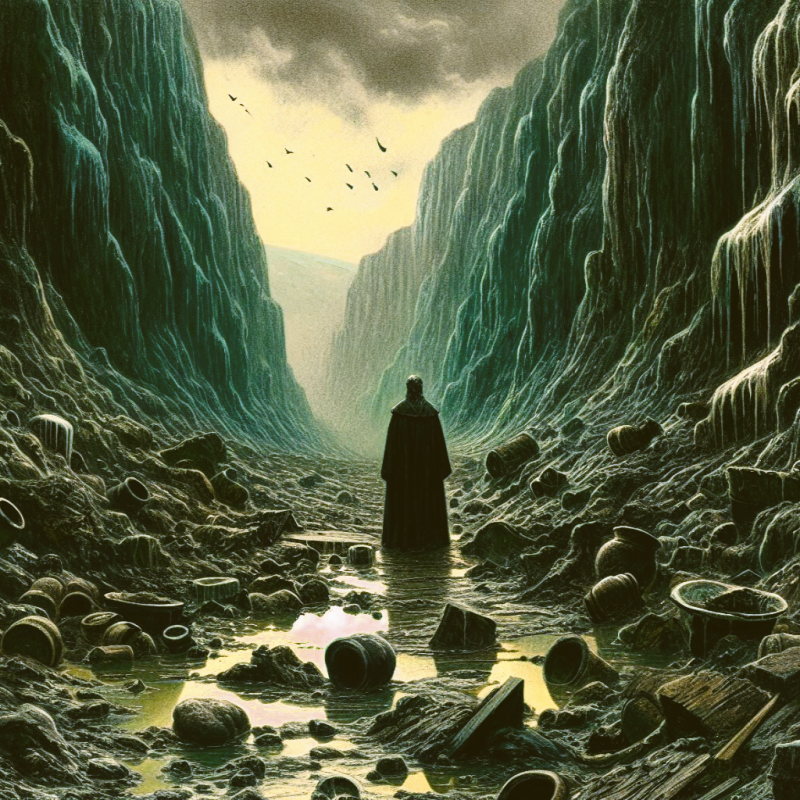
It felt like he was in a great valley: a dark, terrible place. The darkness seemed to crush him. He was vaguely aware of the others. But no one spoke. No meals were served, no one would have eaten. Their fasting was a result of their fear and depression. Jesus was gone; no Comforter had come. Peter stared at nothingness; the great dark terrible valley was the only thing visible.
He sat for hours and hours, staring into darkness, in abysmal dismay and sorrow. Suddenly Mary Magdalene was in the room, excitement bursting from her in a babbling frenzy. She was saying something about the tomb, things that just didn’t make sense. John was talking to her; she calmed a little, repeating her confused tale.
Then John said, “Something’s happened at the tomb. I’m going to check on it. Coming?” For some strange reason Peter jumped up and followed John. It dawned on him that Mary had said Jesus was alive! Excited by the thought he ran past John. Then he remembered his denial and wondered what Jesus would say. Shame and guilt slowed him, John ran ahead. When they arrived John stood outside the tomb, uncertain.
Peter entered the tomb, John followed. It was empty! They examined the burial cloths, but found nothing they could comprehend. Mystified and confused they returned to the others, only to find Cleopas and his cousin claiming they met Jesus on the road to Emmaus. Peter, stunned, sat down in a corner, his thoughts a jumble of uncertain speculation. Then Jesus appeared in the room! It was not his ghost, Jesus had a real body. He even ate some fish.
The next day everyone was excited, celebrating. But Peter wondered about himself. He had denied his Lord. Would he be accepted? He surely couldn’t be “First Disciple” now. He put on a happy face, but inside he was miserable: amazed and joyful that Jesus was alive, but uncertain as to what Jesus thought of him. During the day there was much to occupy him, but at night he still stared into that terrible, dark, lonely valley.
A week later Jesus appeared to the disciples again. The good news was that Jesus had said nothing about him. Even better, they were to meet Jesus in Galilee. And so they headed home, to Capernaum. Maybe, when he saw the sea, he would no longer see that dark valley.